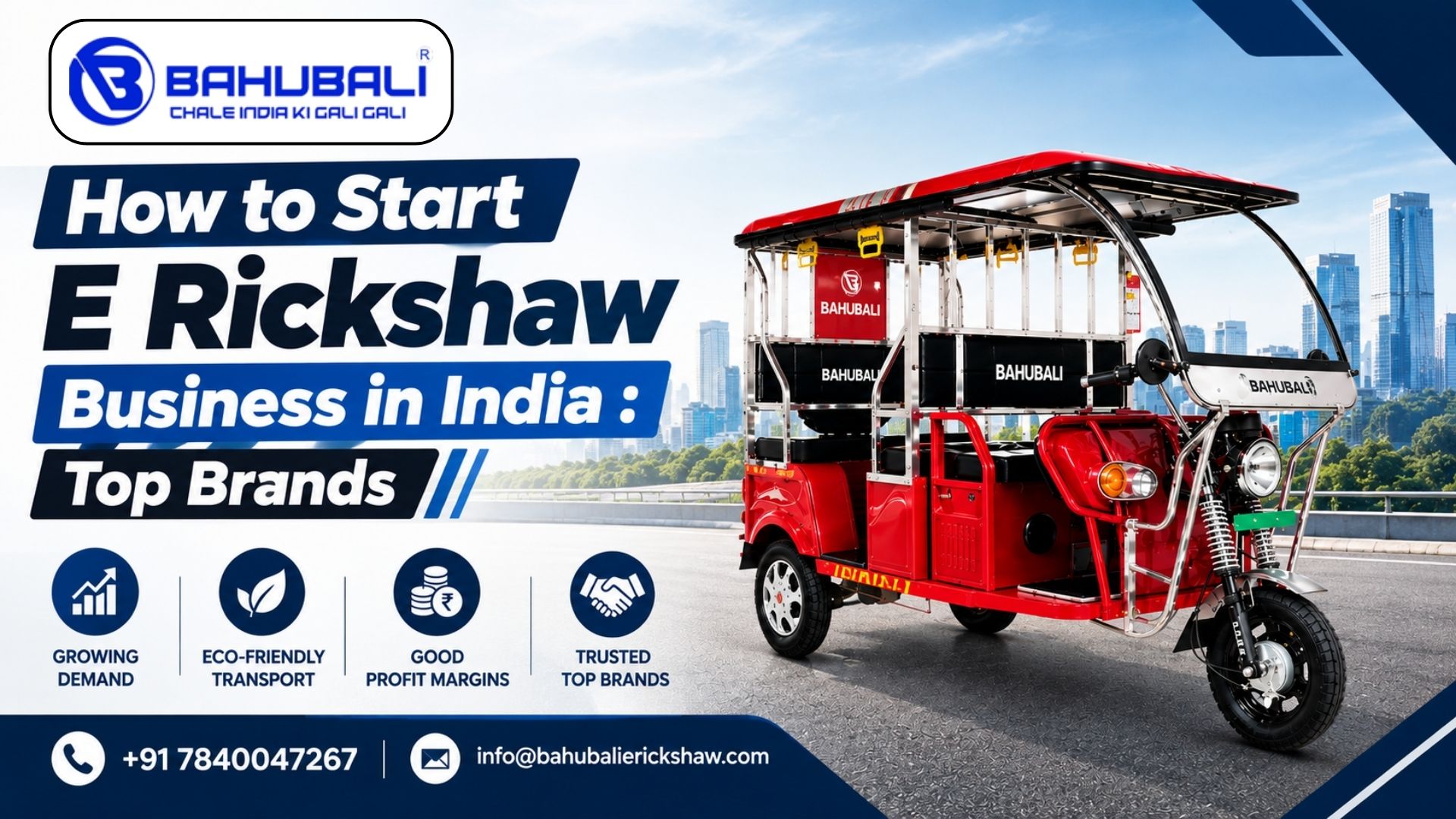
How to Start E Rickshaw Business in India : Top Brands
Introduction
If you are planning to invest in e-rickshaw business then in India there are huge opportunities in passenger transportation, everyday travel and last-mile connectivity. Electric three-wheelers have become an important feature of city and semi-urban transport since they can cover short distances with low maintenance requirements. According to industry data for the financial year 2026, electric three-wheeler sales in India increased to around 8.27 lakh units from 6.99 lakh in the financial year 2025.
However, starting this business requires more than just buying a vehicle. The correct path, vehicle specifications, battery, financing plan, charging arrangement, service assistance and brand reputation can all have a direct impact on your earnings.
Why Invest in E-rickshaw Business in India?
Understanding local transportation demand is important before deciding to invest in e-rickshaw business. Areas around railway stations, metro stations, marketplaces, residential communities, educational institutions and industrial zones are capable of handling regular passenger flows.
The main benefit is that an e-rickshaw can be used for many short-distance rides without the need for petrol or diesel. At the same time, your company budget should include expenses for electricity, battery replacement, maintenance and finance.
Before investing in the e-rickshaw business, calculate your expected daily travels, average fare, charging cost, EMI, maintenance and other operating costs. This provides a more accurate analysis of possible monthly returns.
How Much Capital Do You Need?
The starting price required is affected by the vehicle model, battery technology, financing method and whether you buy one vehicle or a whole franchise.
Your starting budget may need to cover:
-
E-rickshaw purchase
-
Registration and insurance
-
Starting down payment
-
Battery and charging requirements
-
Loan or EMI expenses
-
Maintenance and spare parts
-
Parking or charging arrangements
-
Working capital
Instead of buying a vehicle only based on its purchase price, examine its overall ownership costs. A vehicle with dependable service support and strong performance can be more suitable for commercial use than one chosen only for its low starting price.
Which Brands Should You Consider?
Multiple companies compete in India's e-rickshaw sector, with different strengths. When thinking about how to invest in e-rickshaw business industry, compare brands based on product quality, battery options, service network, spare parts availability, warranty and dealer support.
Bahubali E Rickshaw
Bahubali E Rickshaw is a well-known option for those who are interested in passenger e-rickshaws and dealership opportunities. The company has been active in the electric three-wheeler market for many years, with a focus on manufacture, distribution and dealer support.
Buyers who are interested to invest in e-rickshaw business should think about Bahubali's product range, market position, dealer network and customer support. Before making a purchase, investors should enquire about the availability of servicing and spare parts in their desired operating area.
YC Electric
YC Electric is another popular brand in India's e-rickshaw market. Its proven position makes it beneficial for customers when comparing traditional passenger e-rickshaw options.
When you plan to invest in e-rickshaw business, YC Electric can be compared to other companies based on vehicle features, battery setup, warranty, dealer availability and service access, rather than just brand name.
Saera Electric – Mayuri
Saera Electric, which works under the Mayuri brand, has been active in India's electric vehicle market for many years. Its knowledge of electric vehicles makes it a brand worth exploring.
Vehicle design, battery performance, maintenance requirements, service support and availability of replacement parts are all important factors for anyone interested to invest in e-rickshaw business.
Bajaj Riki
Bajaj Auto entered the e-rickshaw market with its Riki brand. The Riki P4005 passenger variant has a 5.4 kWh battery and a certified range of 149 km and the business offers a 3-year/60,000-km warranty.
Bajaj's official launch information also mentions features including a monocoque body, hydraulic braking and flexible suspension.
Riki could be attractive to buyers who value proven vehicle engineering and service infrastructure for businesses looking to work in the e-rickshaw industry.
What Should You Check Before Buying?
Before you invest in e-rickshaw business, compare these factors carefully:
-
Battery: Check capacity, chemistry, warranty and replacement cost.
-
Real-world range: Consider your daily route, passenger load and traffic conditions.
-
Charging: Understand charging time and whether your operating location has suitable electrical access.
-
Service network: A nearby authorised service centre can reduce vehicle downtime.
-
Spare parts: Ask about the availability and price of commonly replaced components.
-
Warranty: Read what is actually covered and for how long.
-
Financing: Compare down payment, interest rate and total repayment instead of looking only at the EMI.
How Can You Make the Business More Profitable?
When you invest in e-rickshaw business, choosing a route is just as important as vehicle selection. A vehicle that runs continuously on a high demand route can achieve higher usage than one that operates randomly.
Maintain the vehicle on the manufacturer's recommended schedule, monitor battery performance and avoid unnecessary overloading. Keeping accurate records of daily revenue, electricity bills, repairs and EMI payments will help you better measure your company's success.
Conclusion
To successfully invest in e-rickshaw business, analyse the overall company approach instead of just the lowest purchasing price. Bahubali E Rickshaw, YC Electric, Saera Electric-Mayuri and Bajaj Riki are some of the brands that can be selected based on product features, support, warranty and market availability.
A practical route, suitable vehicle, low operating costs and skilled after-sales support can help build a stronger basis for an e-rickshaw business. Before investing in the e-rickshaw business, calculate your estimated income and total monthly expenses to make sure that your selection is based on accurate numbers.

 Call Now ! +91-7840047267
 Email Now info@bahubalierickshaw.com